






































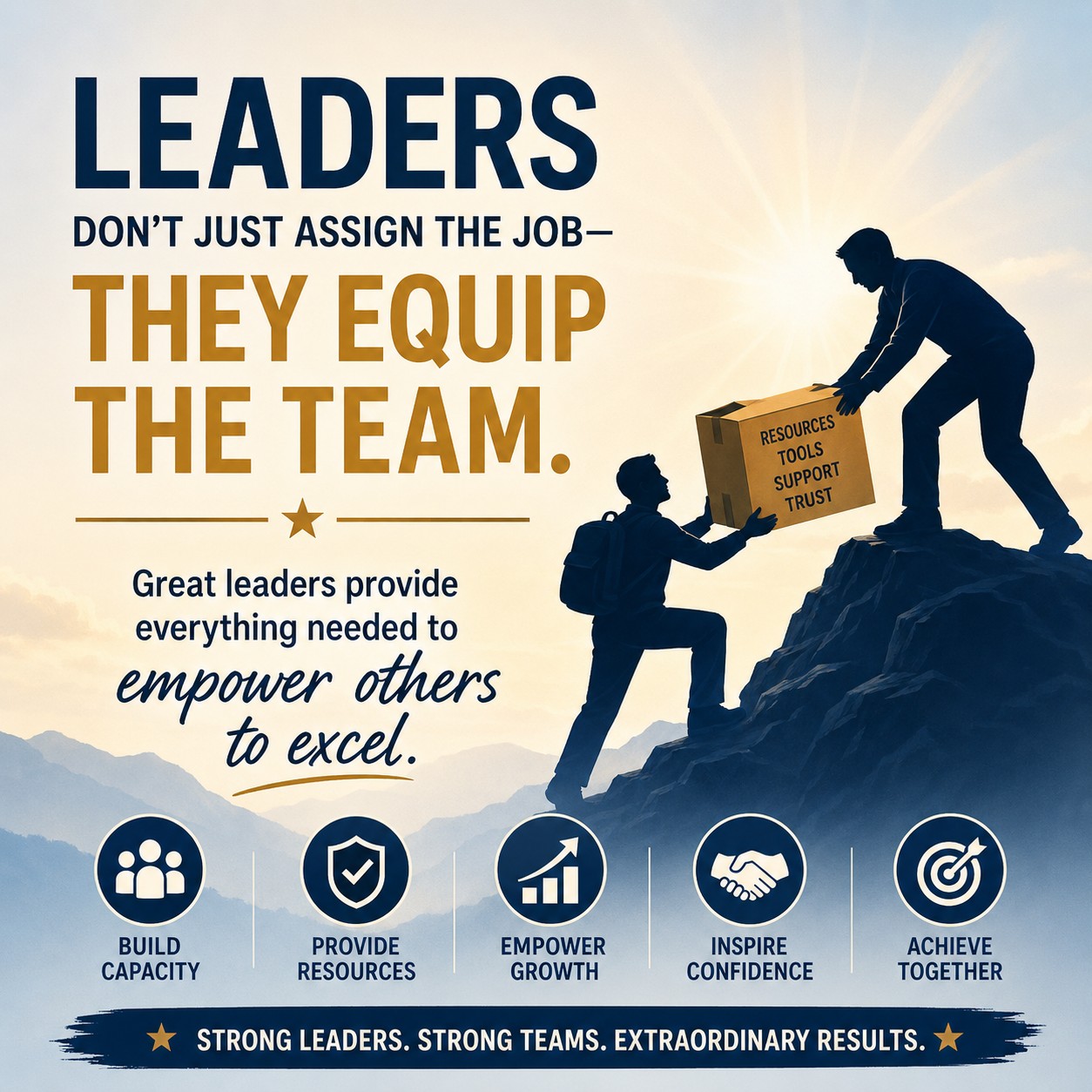
General Colin Powell once observed that leaders should not give the team a job unless they give them everything they need to successfully do it. A major responsibility of leaders is to ensure that those charged with fulfilling a mission, goals, and objectives have the capacity to do it.
Capacity is both organizational and individual. The organization must have the leadership, mission, culture, team, alignment, facilities, systems, technology, budget, policies and procedures, and all other resources required to enable the team to consistently perform at a high level. Team members must have the motivation, knowledge, skills, experience, and expertise to excel. Leaders must build and sustain both organizational and individual capacity.
Organizational capacity results from leaders identifying, creating, acquiring, and maintaining all the elements both internal and external that are needed for consistently exemplary performance. They must have a solid understanding of everything inside and outside the organization which is required to attain the mission, vision, goals, and objectives. This could be personnel, the production process, technology, and the right culture. With their team, they must select, design, implement, and evaluate the right organizational elements which are essential to success.
Leaders equip their teams for exceptional performance by providing everything they need to excel. They listen to their teams. They study key metrics and the production process. They guarantee that the organization has all the elements which produce high performance.
Ideally, a CEO is both visionary and masterful at implementation. However, both qualities are not always found within the same person. The solution is to find other leaders who are strong where you are weak. A leader who is visionary but not implementation-oriented will especially need to surround himself or herself with a team who excels at execution. A common and successful model is for the visionary CEO to hire a COO who is fantastic with implementation.
Leaders will have to ask the right questions to be certain that the proposed plan for continuous and effective execution will work. Leaders must constantly study the issue of organizational capacity always looking for improvements and performance and efficiency gains. Leaders know that the right alignment which matches the organization and operations to the consistent achievement of the mission, goals, and objectives is everything.
Individual capacity is the product of recruitment, hiring, evaluation, coaching, professional and leadership development, and promotions. The focus is optimizing human capacity in terms of knowledge, skills, professional and personal qualities, specific strengths, experience, expertise, confidence, and competence.
You will never be better than your team. Based upon the vision, mission, goals, objectives, culture, and current team, leaders identify, recruit, and retain the teammates who will generate excellence. They know and understand each member of the team and provide the right incentives and disincentives to bring out the best in them. They supply the coaching, experiences, opportunities, and resources to optimize their strengths and minimize the effects of their limitations. They hire teammates who match and fit the mission, culture, and team. They recruit teammates who add new and needed abilities and strengths.
Leaders know that every business is a people business. They understand that the organizations who hire and retain the right teams are far more productive, innovative, and successful than those who do not. They care a lot about employment engagement, retention, career development, and growth as professionals and leaders.
There will be no real or lasting success without the capacity to achieve and sustain it. Optimizing the ability of the organization and the individuals within it to incessantly excel is the mandate of leaders.
Sources: Abrashoff, 2002; Blanchard, 2011; Collins, 2001; Drucker, 2001; Grant, 2017; Kotter, 2012; Lencioni, 2012; Maxwell, 1998; Starling, 2007; Welch, 2005.