PALM COAST, Fla. — Lower property taxes could offer welcome relief to homeowners. But would those savings hold up if local governments introduce new fees to pay for services?
That question shaped a discussion of Amendment 3 at the Palm Coast Community Center on Wednesday, September 30, as speakers and residents examined the proposal’s potential benefits, financial consequences and implications for local control, during a forum hosted by the Flagler Tiger Bay Club.
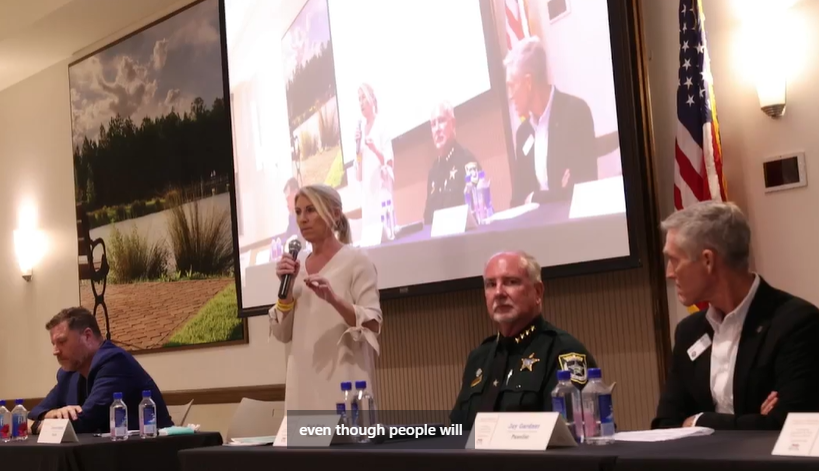
Emcees Jay Scherr and Marc Dwyer guided the public forum, which included Jeff Brandes, Palm Coast Vice Mayor Theresa Pontieri, Flagler County Property Appraiser Jay Gardner, Flagler County Clerk of Court & Comptroller Tom Bexley, Flagler County Supervisor of Elections Kaiti Lenhart and Flagler County Tax Collector Shelly Edmonson.
Tapping into an array of questions, audience members, chosen at random by a bin of numbers, asked about government spending, exemptions, public services and whether some residents could ultimately pay more.
Amendment 3 would increase the homestead exemption for non-school property taxes to $150,000 in 2027 and $250,000 in 2028, with inflation adjustments thereafter. It also would lower the annual assessment increase cap for non-homestead properties from 10% to 5%. The proposal, which has already faced several challenges, goes before Florida voters in November.
For Pontieri, the proposal presents an opportunity to change how local governments approach their budgets, putting greater emphasis on what taxpayers can afford and which services deserve priority.
“What we should be saying is, here’s our budget, and we need to adjust our expenditures to meet that budget,” she said.
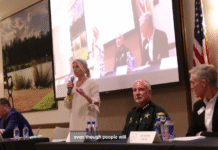
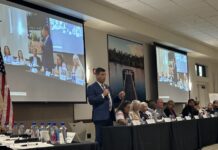
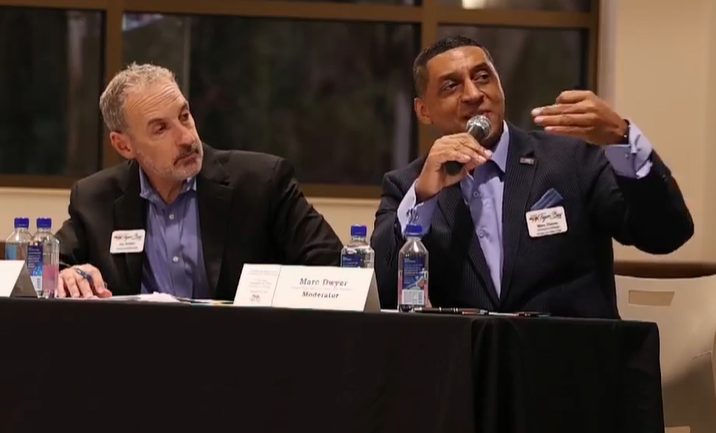
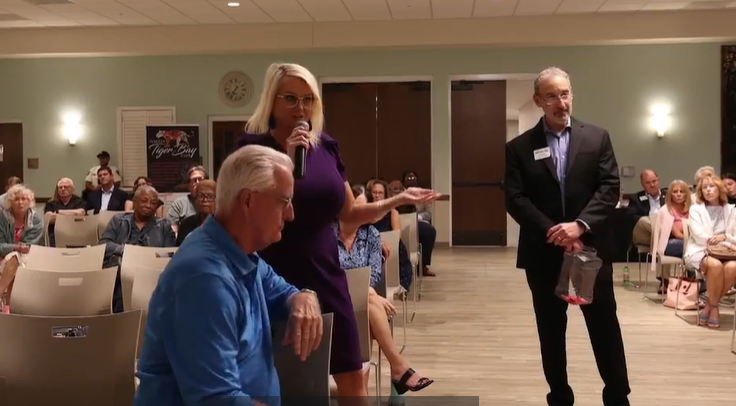
Cohost Marc Dwyer poses a question to the panel.
Pontieri argued that governments should begin identifying efficiencies, considering consolidation and asking residents what they want funded. Responding to an audience member’s suggestion that citizens help examine budgets, she called for more attention to solutions if the amendment passes.
“Why don’t we put that energy into coming up with solutions?” she asked.
One option discussed throughout the evening was replacing some property tax revenue with assessments or fees dedicated to particular services.
Pontieri said a fire assessment could make costs more transparent because the money would be dedicated to fire services, rather than collected as unrestricted general fund revenue. She also pointed to the study required to establish such an assessment as an opportunity to identify the service’s actual cost.
“It provides for transparency, and it lets you, as a taxpayer, know, what am I paying for fire specifically?” she said.
Brandes, however, cautioned that changing the collection method would not eliminate the expense of providing services.
He identified fire and stormwater assessments as potential ways local governments could replace lost revenue. Beyond those options, he said, communities would face difficult choices about spending reductions and other funding sources.
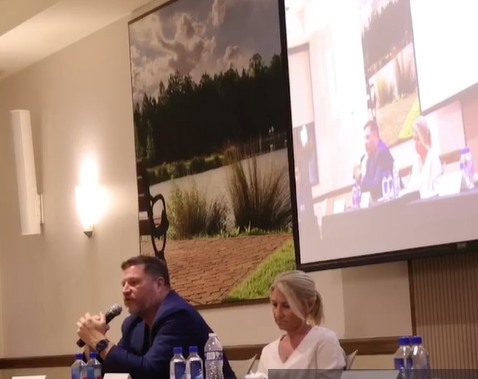
Policy expert Jeff Brandes fields questions during the forum.
“There’s going to be some hard other cuts,” Brandes said.
Bexley offered a historical perspective, recalling the collapse in property values during the housing downturn and the resulting pressure on government budgets.
At the time, he was working under then-Clerk of Court Gail Wadsworth. Reducing spending meant cutting employees, he said, because personnel accounted for the overwhelming majority of the office’s expenses.
“When we’re asked to take cuts, there’s only one place for us to take it,” Bexley said.
He recalled double-digit staff departures and said rebuilding the office had taken nearly 20 years. His account underscored a concern running through the discussion. Large revenue reductions can drastically affect the people who deliver public services.
Gardner distinguished the proposed increase from the earlier expansion of the homestead exemption from $25,000 to $50,000. The scale of the current proposal, he said, would create a substantially different financial challenge.
Pricing Out Seniors and Veterans
Residents pressed the panel to explain what those changes could mean beyond their property tax bills.
Audience member Lacy Martin, an active voice in the discussion across the community, asked who would decide which services take priority and how parks, libraries, mosquito control, fire protection and law enforcement would be funded.
“I want to save money on my property tax bill. I would love to,” Martin said. “But how are we gonna fund the essential services?”
She called for a clear local explanation of potential fees and service changes before voters make their decision.
Lacy Martin asks a question about who decides what gets funded during the forum’s audience participation section.
Pontieri acknowledged that communities might need to consider fees for parks, recreation and libraries. She suggested that user fees could give residents more choice about which amenities they support.
Her examples included a possible library fee or annual park pass.
The prospect of new charges raised another concern. Residents who currently pay little or no property tax might receive little benefit from a larger exemption while becoming responsible for additional assessments.
One audience member asked about disabled veterans and other exempt homeowners, questioning whether anyone could guarantee that new fees would remain below the tax savings.
Gardner said some residents could end up paying more.
He cited 1,954 veterans receiving full exemptions and 627 receiving percentage-based exemptions related to combat disabilities. Including other homesteaders and seniors with lower-value homes and substantial exemptions, he said approximately 5,500 could be vulnerable to higher costs under a shift toward fees.
Those residents, he said, were “in jeopardy of paying more, not less.”
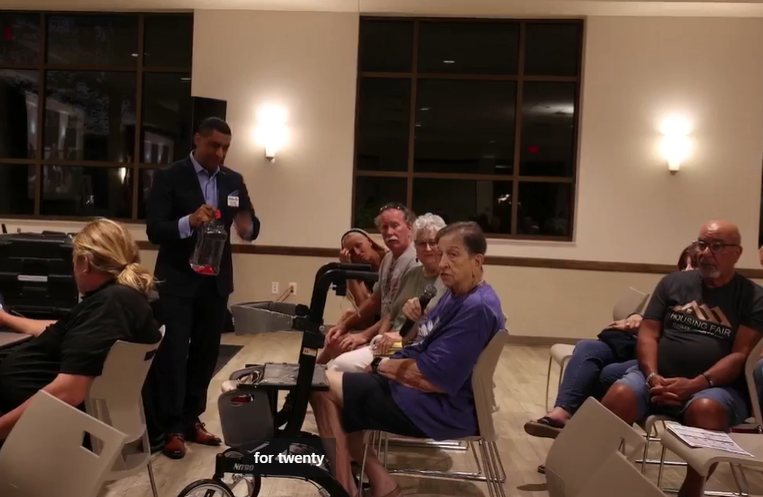
Resident Betty Cabot asked about why there was a huge difference in the proposed homestead exemption amount as part of the audience participation section.
New In Town
Questions about fairness extended to newcomers and renters who later purchase homes.
Responding to an audience question about growth, Brandes and Pontieri offered different interpretations of the proposed waiting-period provisions. Brandes emphasized the number of homestead exemptions received, while Pontieri emphasized established Florida residency and argued that existing residents should receive protection from growth-related costs.
Gardner said implementation would require determining eligibility and predicted that the waiting period would face a constitutional challenge. That prediction concerned a possible future court outcome, rather than an existing ruling on the provision.
The exchange illustrated why the panel repeatedly encouraged residents to read the proposal carefully.
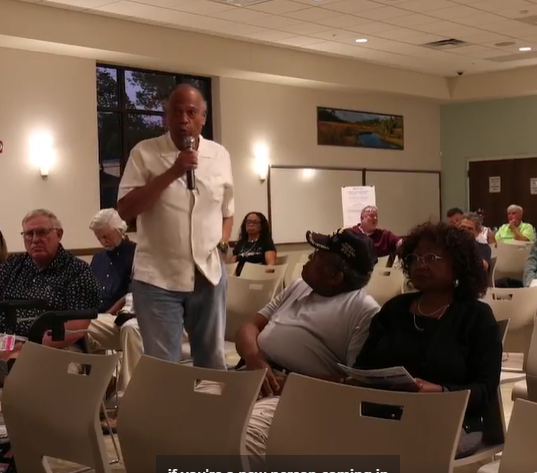
Greg Davis shares a question during the public participation section of the forum.
Who Makes the Rules and Who Pays?
Local control was another dividing point.
Pontieri described herself as a strong advocate for home rule and said dedicated local assessments could help communities avoid greater dependence on Tallahassee.
Brandes warned that financially vulnerable counties could become increasingly reliant on state assistance, giving state leaders more influence over local decisions.
“When Tallahassee writes the checks, Tallahassee makes the rules,” he said.
Other audience questions addressed possible homestead fraud and whether a smaller exemption increase would be easier for communities to absorb.
Gardner said his office investigates improper exemption claims and can pursue back taxes and penalties. Brandes explained that the existing exemption structure includes a taxable gap, an element that complicates direct comparisons between the current system and the proposed expansion.
Who Decides? You Do.
As the discussion turned toward voter participation, Lenhart encouraged residents to research both candidates and amendments.
She said turnout had averaged approximately 63% across the previous three midterm election cycles, emphasizing that election outcomes are determined by those who participate.
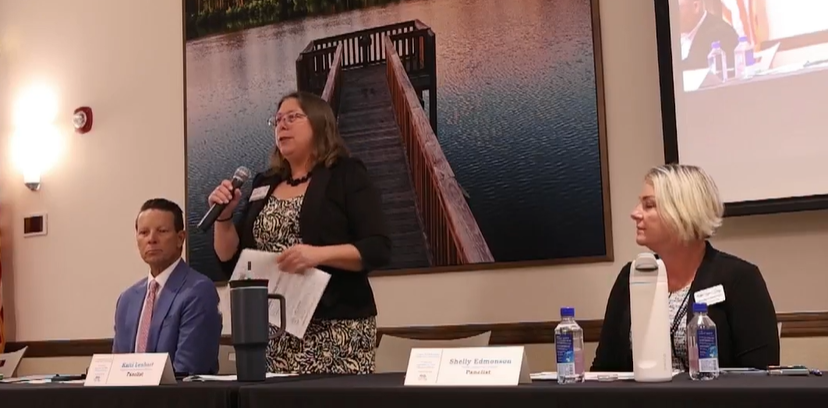
Flagler County Supervisor of Elections Kaiti Lenhart shares election stats during the forum.
“My encouragement to you all is to get out and vote, make sure that you research your candidates,” Lenhart said.
The forum closed with a reminder that its purpose was to present different perspectives and give residents an opportunity to ask questions.
For voters, the debate left a practical question to weigh alongside the promise of a lower property tax bill. What would the impact be on the community’s services, and how would they pay for them?
With too many things about the amendment still unclear, there is a silver lining according to Gardner – the Florida Taxation and Budget Reform Commission meets in 2027, and there’s still a chance to fix it.