



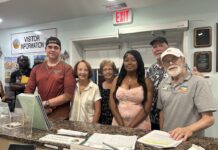





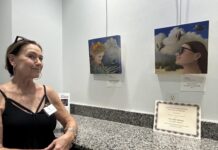
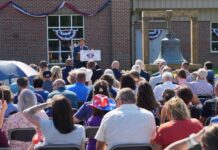

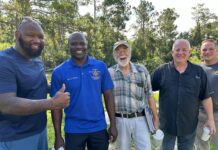


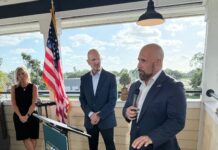















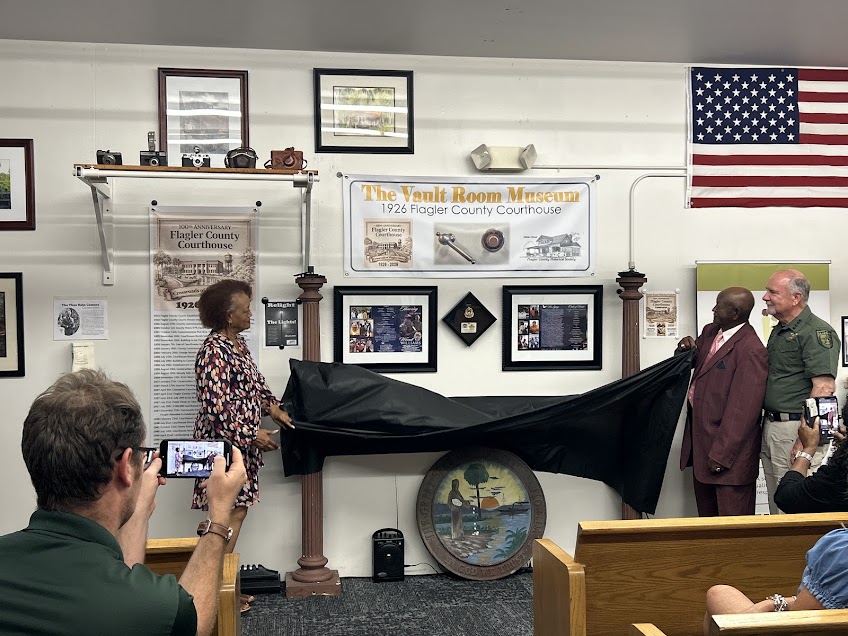
BUNNELL, Fla. — Inside the 1926 Vault Room Museum at the Historic Flagler County Courthouse, family members, lifelong friends, law enforcement colleagues, and community leaders gathered Saturday, May 16, to honor the life and legacy of Detective Lieutenant Warnell Williams — a man remembered not only as a pioneering law enforcement officer, but as a trusted friend, mentor, storyteller, and beloved member of the Bunnell community.
Standing room only, the event celebrated the unveiling of several historical artifacts in the exhibit recognizing Williams’ decades of service and lasting impact on Flagler County history. Throughout the event, half a dozen speakers reflected on his quiet leadership, sharp investigative instincts, humor, and unwavering connection to the community he served.
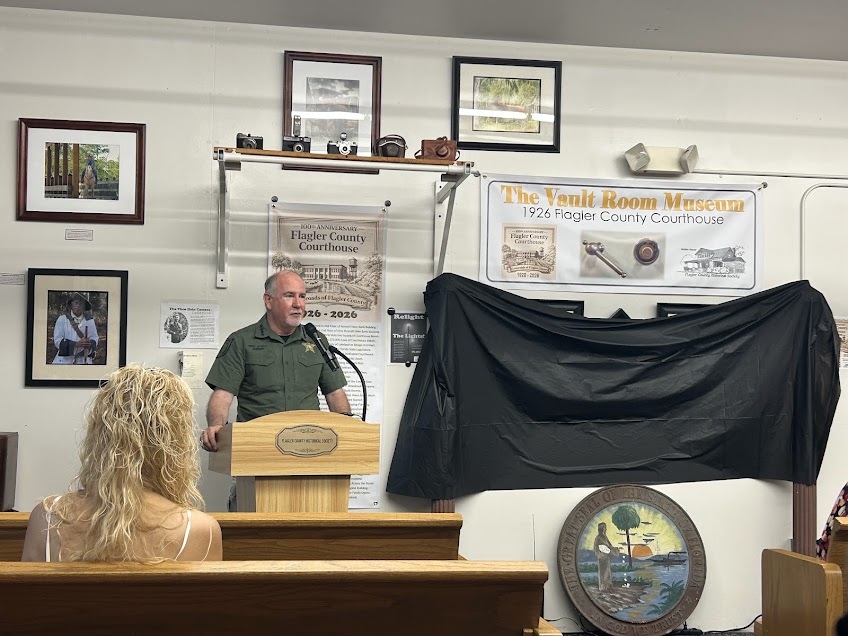
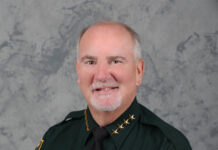
Flagler County Sheriff Rick Staly described Williams as a “trailblazer” within the Sheriff’s Office.
“He was known throughout the community as a steady, dependable, and respected presence, someone who carried himself with integrity and treated others with dignity and fairness,” Staly said. “If you were a criminal, you did not want Warnell after you.”
Williams began his law enforcement career with the Flagler County Sheriff’s Office in 1974 after being hired by Sheriff Zip Edmonson. Over many decades, he served under seven sheriffs before retiring in 2003. Staly noted that Williams preferred working undercover, often avoiding openly displaying a badge or firearm because he never wanted to intimidate people.
“Lieutenant Warnell Williams, well done. Thank you for laying the foundation for so many others,” said Staly.
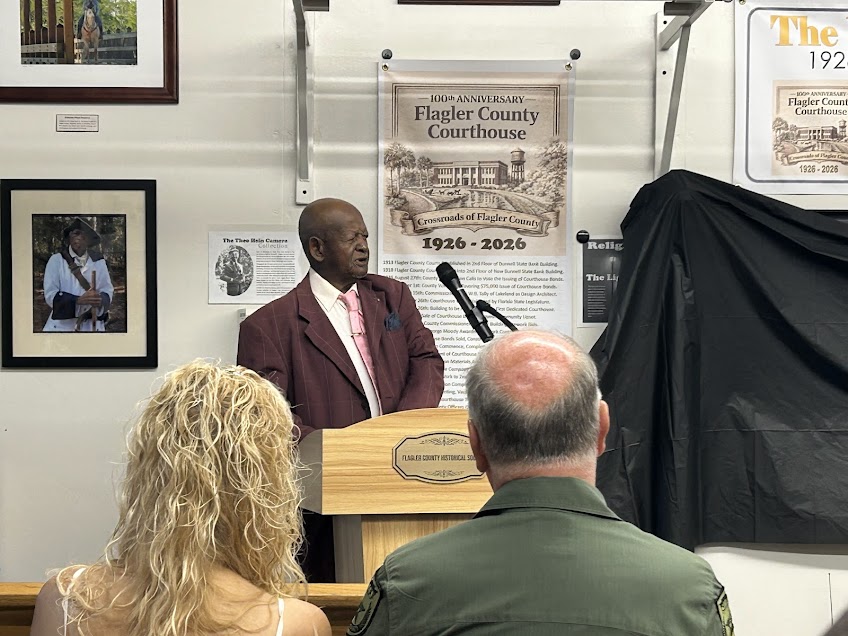
For Williams’ family, the dedication was deeply personal.
His sister, Rozell Swain, and brother David Williams, shared memories of growing up alongside a brother who always seemed to be everywhere at once.
“Warnell was everywhere at the same time,” she said with a smile.
“We grew up that way. Never got a chance to really see him at a younger age because he was always out doing something — getting into trouble,” she teased.
Swain reflected on the countless afternoons through the years she would find her brother at the South Jiffy store, scratching lottery tickets while catching up with friends and neighbors.
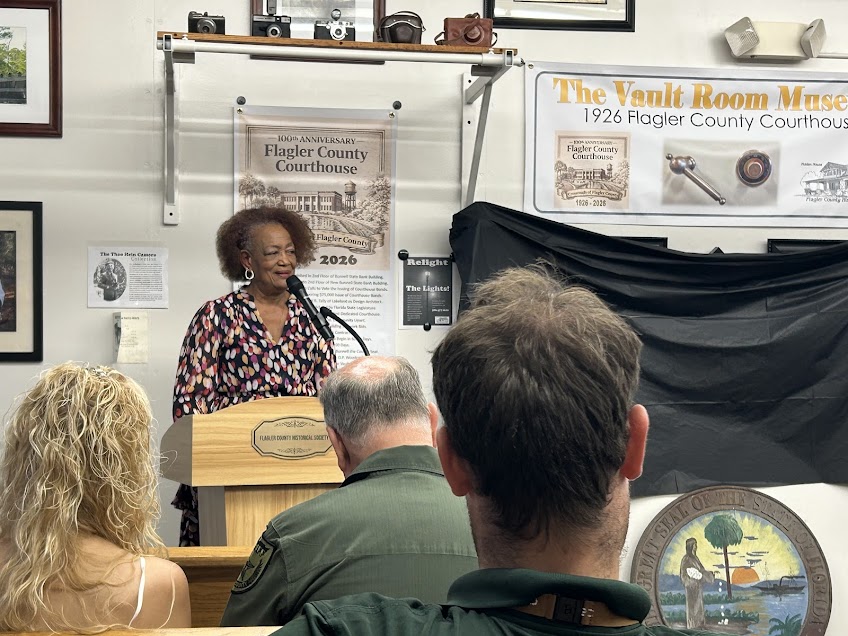
“When you couldn’t find him at the Jiffy, you would find him down under the tree,” she said. “Coming back through Bunnell is never going to be the same again. I’m going to miss him.”
His oldest daughter Francena J. Koch credited Flagler County Historical Society President Ed Siarkowicz for helping make the tribute possible.
“We have to give Ed some credit,” she said. “He’s easy to work with. He’s kind-hearted. He kept the texts coming saying, ‘We want to do this.’ It just took off from there.”
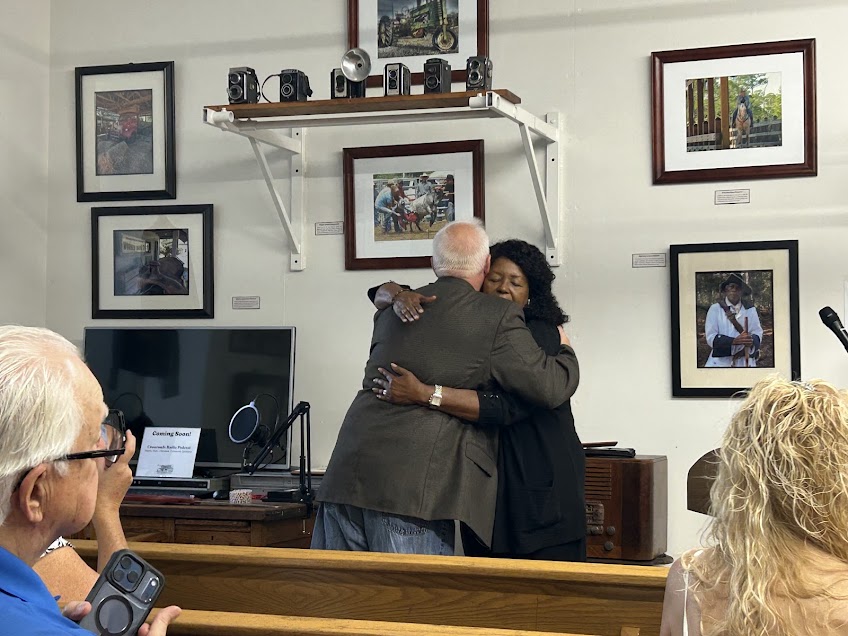
Siarkowicz explained that the exhibit represents a broader effort to preserve and tell the stories of Bunnell’s Black community — histories that were largely absent from museum collections when he arrived seven years ago.
“When I came in here, there was very little information hanging on the walls about Bunnell’s Black community,” Siarkowicz said. “Last year, we took in 30 boxes of photographs and negatives from photographer Theo Heim, and we saw such an equal representation of the white and Black community through his camera lens.”
He described the dedication as one of those moments in life where “the Lord leads us exactly where we’re supposed to be at the right place at the right time.”
Friends and former colleagues painted a vivid picture of Williams’ personality and investigative talent.
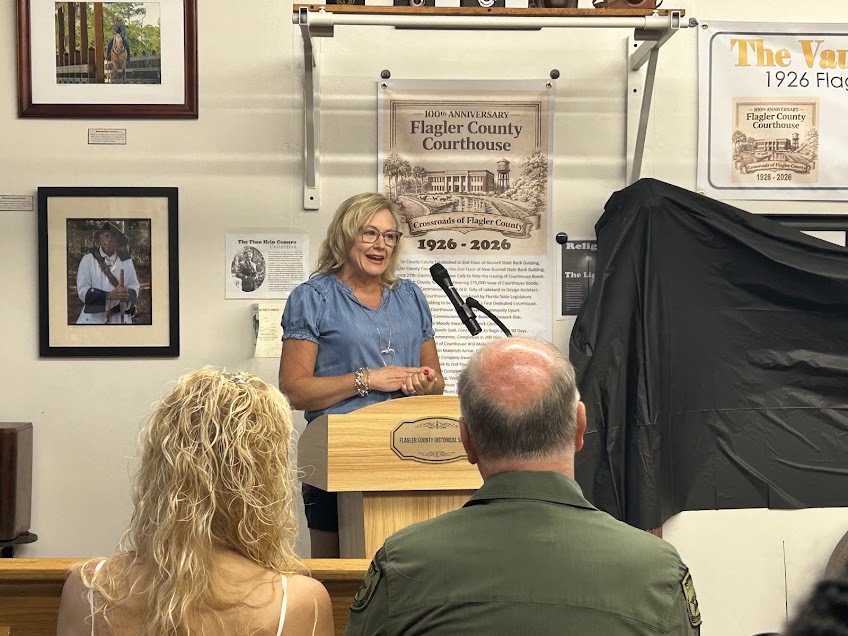
Shelley Hunter recalled that Williams helped solve the county’s only serial killer case, though he never sought attention for his accomplishments.
“His success spoke for itself,” said Hunter, whose father Wilfred Hunter worked with Williams for 40 years. “He was a man of very few words, but if you knew him, you knew what kind of man he was.”
Retired law enforcement officer Bub Robson shared stories spanning more than five decades of friendship via telephone, including how the two met over a cows and a car accident, recalling Williams as “a walking human computer” and “a great guy.”
Others, like former Florida Highway Patrol officer and current Bunnell City Commissioner Pete Young, remembered Williams as a crime solver and a fishing buddy.
“We had a good time,” Young recalled fondly. “We went fishing together. We’d go out in a boat. Didn’t ever catch any fish, so I had to go stop by Publix, get a few fish. But, yeah, we worked together a lot.”
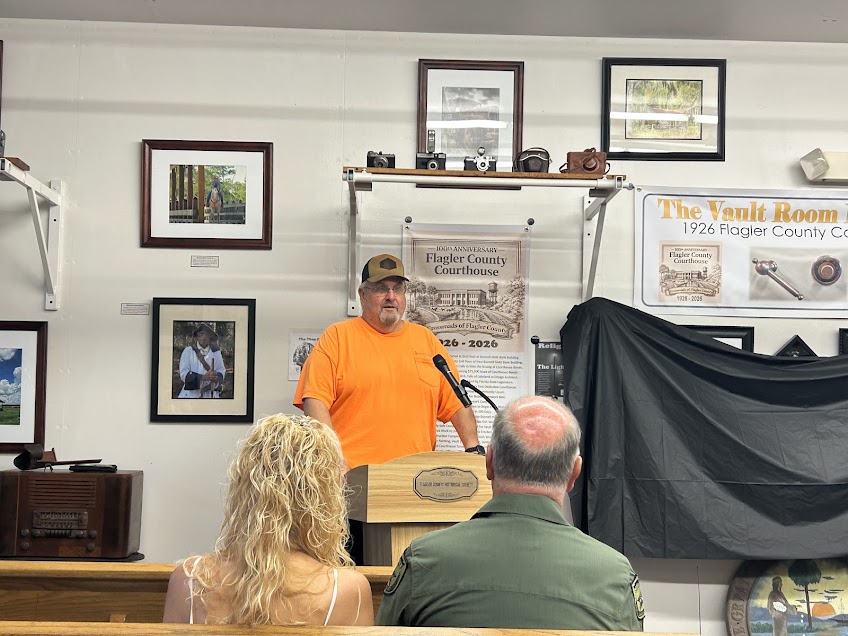
In a letter read during the ceremony, Bunnell Police Chief David Brannon wrote that officers were routinely directed to seek Williams’ help when trying to identify suspects or understand local history.
“That kind of legacy cannot be measured by rank, title, or years of service,” Brannon wrote. “It lives on in the people Warnell helped, the officers he mentored, the history he preserved, and the friendships he built.”
The dedication also highlighted the importance of preserving community history before it disappears.
“As I got older, I loved history,” Sheriff Staly said. “Once history is torn down, it’s gone. The only way we can keep it alive is with museums and people willing to preserve it.”
Saturday’s gathering served as more than a memorial. It became a reunion of stories, memories, laughter, and tears — all centered around a man whose influence stretched far beyond a badge.
As guests toured the exhibit and shared refreshments outside The Vault Museum, one message echoed throughout the room, Detective Warnell Williams’ story is now permanently woven into the history of Flagler County.