
















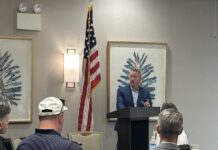


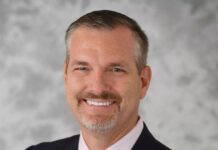

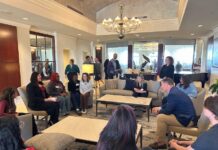












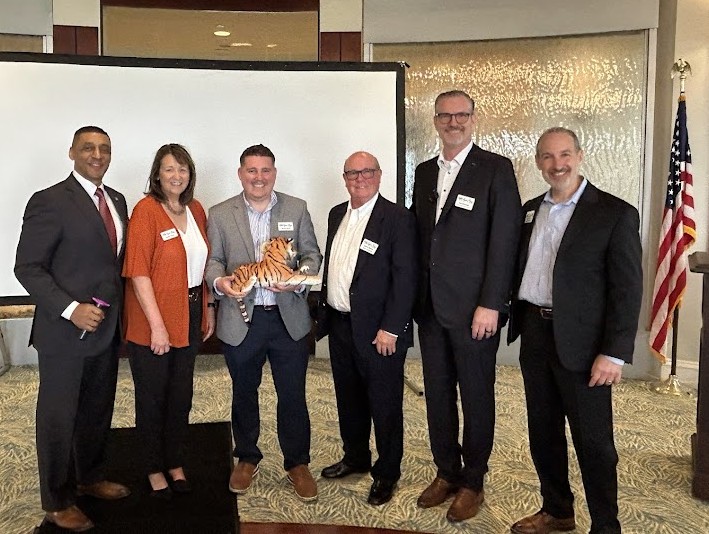
PALM COAST, Fla. – At the March meeting of the Flagler Tiger Bay Club, thoughtful dialogue took center stage as community leaders gathered to hear from Rob Deininger, CEO and president of AdventHealth’s East Florida Division. But it was a compelling, real-world question from Flagler Tiger Bay Club corporate member Derrick Hardin, Assistant Vice President of SouthState Bank, that ultimately earned him the club’s coveted Fang & Claw Award for “Best Question.”
Deininger’s presentation focused on the evolving landscape of healthcare, emphasizing both the challenges and opportunities facing providers and patients alike.
“I’m hoping that they walk away understanding that there’s a lot of conversation about healthcare going on right now,” Deininger said. “A lot of that is in economics, but the economics actually play out into meaningful things that are happening in our markets—good and bad. And so my goal is to kind of raise awareness on some of those issues, but then finish with what is a really positive story about what’s actually being fixed and what’s really going well.”
He also highlighted the importance of collaboration within the community, noting, “I think great communities are made up of three things—a business community, an education community, and a healthcare community. And we feel really fortunate in Flagler County to be the healthcare system that takes care of Flagler County.”
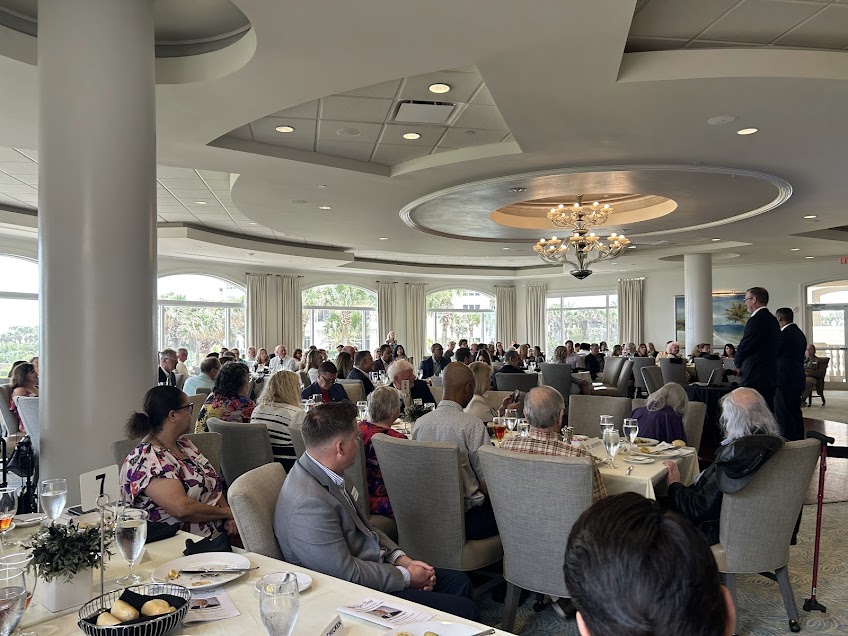
The discussion turned personal and impactful as audience members shared experiences and posed questions rooted in real-life healthcare challenges. Among them, Derrick Hardin stood out with a question that blended professional insight with personal connection.
“Great presentation,” Hardin began. “I would be remiss if I didn’t ask the question about nurses specifically. My wife is a nurse for Advent. She’s specifically a nurse navigator, which helps in her case, oncology patients navigating the healthcare system.”
He continued, asking whether there would be an expansion of nurse navigation services across other specialties and conditions—particularly for patients who may struggle to access or afford the care they need.
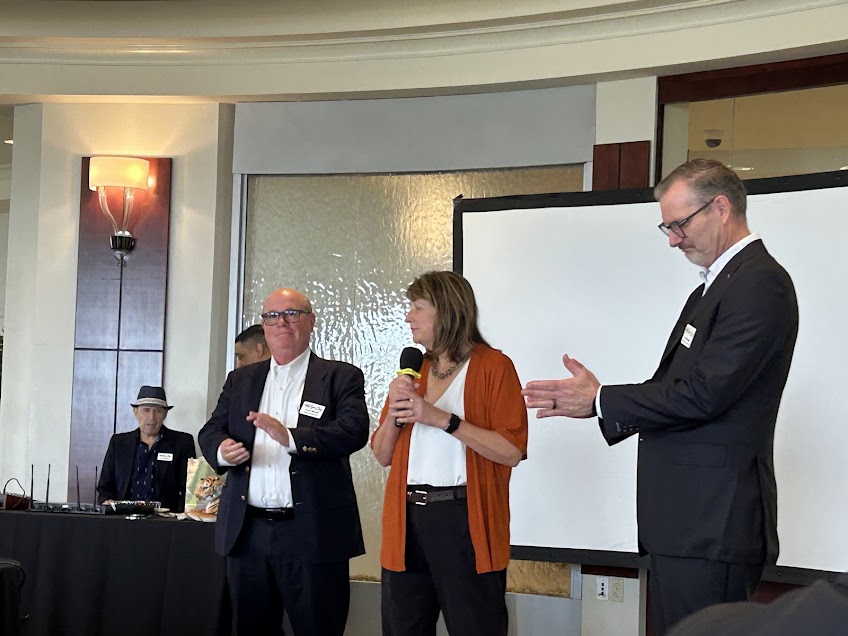
“Do you see an expansion…for chronic conditions, or maybe acute conditions where you guys aren’t able to collect funds that otherwise you would miss out on because they don’t have access or knowledge to get resources financially, and then be able to see providers that they need to see…for their condition?” Hardin asked.
The question struck a chord, prompting an in-depth response from Deininger, who affirmed both the importance and the future growth of patient navigation.
“Absolutely,” Deininger replied. “I think oncology has been one of the frontrunners for the advantages of navigation. Healthcare is a complex business, and despite best efforts to try to make it seem more simple, that continues to be challenging to navigate.”

He emphasized the human impact of navigation services, adding, “I think the importance of taking someone from a diagnosis into a clear understanding of what a path and a journey looks like is so important to their mental health, to their ability to stay focused on recovery and getting well. And so, every amount of energy we spend on navigation is worth it.”
Looking ahead, Deininger also pointed to innovation as a key component in expanding access. “We think about AI. You pair AI with a nurse…how do we extend that nurse so he or she can see more, navigate more people with the right answers, and get them into that provider as quick as possible.”
The depth, relevance, and forward-thinking nature of Hardin’s question earned him the March 2026 Fang & Claw Award, a recognition given to the member who poses the most impactful question of the event.